Interview: Cornish Bakery fires gun on RISE concept
The opening of the largest Cornish Bakery outlet – in Portsmouth Harbour – out of its estate of over 80 outlets moves the business beyond baked goods and into small plates dining and alcohol for the first time and is merely the latest excursion for its founder who retains a restlessness.
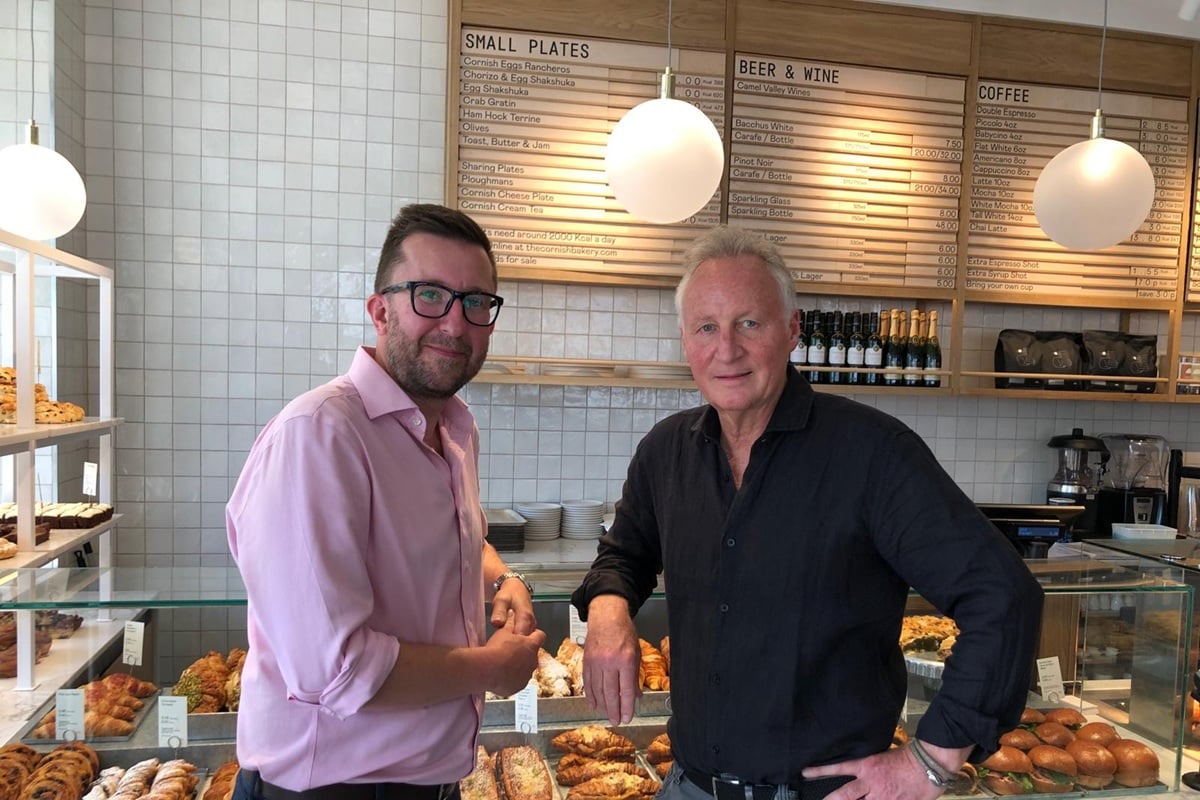
The Retail Bulletin interviewed Steve Grocutt (pictured right with MD Mat Finch), founder of Cornish Bakery, who was in buoyant mood celebrating the unveiling of his new Gunwharf Quays site that is the second of its new RISE by Cornish Bakery concepts after the first opened in late-April in Betws-y-Coed, Wales, after delays to the Portsmouth unit.
Subscribe to TRBAll a bit 90s really…
Before describing this latest venture it’s worth winding the clock back to the early days of the business when he says his starting point in retail and hospitality was “all a bit 90s really”. He recalls in 1994 when living in London and his dad suggested he open a pasty shop in Mevagissey, Cornwall. He went along with it because he saw it as a route to fund his travelling during the winter months.
“The first summer we tried it, with the local butcher’s wife making the pasties, and I bought a till. We got it all wrong but the next year we’d done it right and we moved onto four, five, six sites all in tourist hotspots – including Newquay, Falmouth, St Ives and Penzance,” he says.

After a few years he’d less of the travel bug and he’d also met his wife. It was time to grow the business in earnest: “We did the tourist spots across the UK when at the time it was all Costa and Caffé Nero.” As well as innovating with the flavours of his pasties – away from the traditional Cornish mix of beef, potato, Swede, onion, salt and pepper – Grocutt also recognised early on the value of bringing coffee into model. Today it is the best-selling item across the group.
Building out the proposition
In addition, he built-out the food proposition beyond pasties because they are predominantly sold between 11am and 3pm, which left plenty of dead trading time through the day. This involved introducing other baked goods into the mix whereby pasties today account for less than a third of overall sales. Refining this model led to him concluding in 2019 that the UK was ripe for bakeries to be brought back to the high street around the UK.
“The supermarkets had led to the closure of many bakeries and I felt there was an opportunity for modern bakeries – not bread but coffee and Cornish pasties, cakes and buns,” he says, adding that each site has its own bakery with some goods produced from scratch and others completed by ‘bake-off’.
“The open-plan bakeries enable customers to see the baking in action. People are fascinated by it and it creates a different vibe. I find it an active and uplifting vibe,” he suggests, adding that there is still a healthy amount of take-out trade – which accounts for roughly 50% of sales.
In the early days he says the units all looked the same but he has abandoned the identikit approach. “We’re taking the opposite of the cookie-cutter approach. We’re purposefully designing bespoke, flexible environments that showcase and optimise our bigger spaces, and experiential opportunities. These are already becoming places for the local community to host talks, exhibitions, classes and events. It’s about community, architecture and the people,” he explains.
In the past five years the company has doubled its number of bakeries, grown the team to over 1,000, quadrupled profit (EBITDA of £4.5 million on sales of £36.4 million) and has developed NPS scores of an impressive 75%. At Gunwharf Quays it is the top-performer at the shopping centre. “Five to 10 years back we all went to coffee shops, now bakeries are the new coffee shops,” he says.
Relaxing the branding
Over time the brand has very much been relaxed and while Cornish Bakery adorns the fascia of some stores, others simply have the company’s logo. Such manoeuvres contribute to avoiding what Grocutt regards as the biggest threat to the business – predictability.
“Our greatest threat is our predictability. We’re fully committed to going our own way, to going full throttle anti homogeneity, and to optimising our fiercely independent spirit at every turn. We are resolutely not a chain we are a group of high-end bakeries. We’re continually redefining what a bakery is, does and can be. And for me, and for my ever-growing team, that can be anything. Long live non-conformity,” he says.
It is this viewpoint that has helped drive his creation of the RISE concept. He had recognised that Gunwharf Quay is for shopping and so customers could be served at breakfast, lunch and into the evening. He had mulled over doing small plates and alcohol at some point and when the Gunwharf shopping park was redeveloped the opportunity presented itself for Cornish Bakery to upgrade to a much larger unit. The 3,500 sq ft site (versus some of the company’s smaller units that measure only 400 sq ft) sits over two-floors with 200 seats across an orangery, an outdoor terrace, a first-floor balcony, and a dedicated space for community baking and barista classes.
Alongside signature pastries, cakes and coffee, there is now a brunch and all-day small plates offering as well as Cornish beers from Harbour Brewery and still and sparkling wines from Camel Valley Vineyard. The dishes are cooked from scratch and served until the unit closes at 8pm. The Betws-y-Coed site jumped ahead of the Portsmouth opening and so after a couple of months’ trading there Grocutt says he is confident of RISE as a concept that can be grown and also elements of it can be incorporated into smaller units.
The forthcoming Shrewsbury store sits between a RISE and regular Cornish Bakery outlet in square footage and as such it will have some brunch items added into the mix and potentially a bar area. “We’re not doing the same everywhere,” he says.
Grocutt had sought to sell the business last year but says the combination of the Government driving uncertainty in the marketplace and some of the “strings” attached to the offers he had received were prohibitive to him completing on any deal. A private equity acquisition/investment would know doubt have sat uneasily because Grocutt says their strategy is invariably “fast growth and sell it on”.
Avoiding unprofitable units
This runs the risk of sub-par performing outlets being opened, which Cornish Bakery has been very careful to avoid over the years: “The whole estate is profitable. If you have an unprofitable tail it can bring you down. I’m laissez faire on expansion. If it’s a nice unit then we’ll have it. It’s not a case of having 100 or 200 units, we need our people to be happy and the stores profitable.”
He reveals that every year is a record trading year as the company continues to grow – with 30% year-on-year growth for the most recent 12 months – and most importantly life-for-like sales growth of 7.9%, which is not all down to price increases.
With the business still in his hands he admits to legacy now being talked about a lot. “Is there a better way to do business? We put people first, with a happy team leading to happy customers that leads to results. Many big employers are broken [models], with their bad cultures and management so people move on,” he says.
He suggests Pep Guardiola, outgoing coach of Manchester City, would not have won all the titles he has with 80% turnover in his team, which is the case within most hospitality businesses. This has led Grocutt to ponder if a business of scale be built differently: “Can you build a collection of independent bakeries and retain the culture. Can the business be bigger and still be authentic and in turn show that there is a better way to do business and change hospitality for good? Companies often fall into the trap of growing for the sake of money.”
Photo credit: Colin Fielder