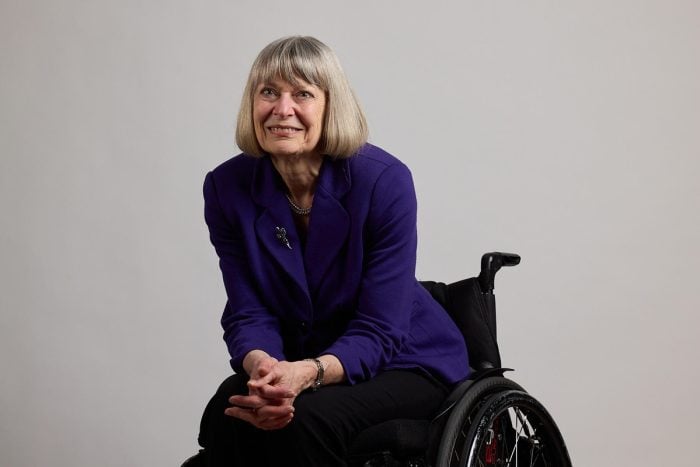
Retail leaders must open up about disabilities
Sara Weller is the only FTSE100 board director with a declared disability, which is an incredible statistic when you consider that there are around 1,000 directors in these companies, and she regards this scenario as damaging on multiple fronts.
Today she is a non-executive director of Virgin Money and BT as well as on the Government-related boards and is co-founder of ActionAble that has just released the Disability Index 2026. Weller says it highlights the missed opportunity: “Disability inclusion is the business equivalent of an open goal. Businesses who better understand the diverse needs of the circa one in four customers who are disabled will build loyalty amongst a consistently underserved customer group.”
Subscribe to TRBInclusion failings
She was the leader of Argos back in the 2000s when it was at the forefront of using the internet within the retail sector and was a pioneer in developing a multi-channel approach. But in 2009 she was diagnosed with MS and went on to leave the business in 2011.
“It was a progressive diagnosis that was not treatable and not predictable. I was in a public-facing role and my job at Argos was a feeder role into the CEOs job at parent company Home Retail Group. I felt I was not able to do it and was blocking the successor of the CEO. I did not know how fast the illness would be and I did not want people to see me get more disabled. The then CEO said it’s no problem with using a wheelchair. It was more me, believing it needed a fully fit person to run Argos and then replace him,” she explains.

Weller chose instead to take up non-executive roles – initially at United Utilities and Lloyds and at The Department of Local Government with Eric Pickles. She says this was “perfect really, with super flexibility”. Thankfully she says things have moved on with people’s views of disability now being much more inclusive, with “disabilities not now seen as a reason to not do stuff”.
Sadly this mind-set does not appear to have translated into the thinking within major businesses. The fact Weller remains the only FTSE100 director with a declared disability after almost 15 years in such a role is damning. Within the index sits a raft of retailers comprising: Burberry, Sainsbury’s, JD Sports, Associated British Foods (Primark), Games Workshop, Kingfisher, Tesco, Next and Marks & Spencer.
Time to declare disabilities
She says there are obviously other disabled directors in these 100 companies but they have not declared: “People often say it is personal but if you run a business and do not declare your disability then it shows employees [in the company] they should also not declare it.”
The reality, according to Weller, is that employees do not share their disabilities unless they are really confident they will then be treated with respect and be supported by their employer. “If they feel they will not be looked after then they will not share and will try and get away with [not declaring] it,” she suggests.
Weller calculates that four million people are employed by the FTSE100 companies of which accepted statistics suggests one in six will be disabled that equates to between 600,000 and 700,000 people who look up to boards but there’s only one role model [Weller]. “Lots of employees simply do not see a role model,” she says.
“At ActionAble we talk to business leaders who say they are too busy with gender and race or that they don’t have enough disclosure of disabilities in their businesses. Well it’s not surprising because they are not trusted by their employees,” argues Weller.
Need to improve reporting levels
Despite the growing openness about neurodiversity and disability, most businesses have been slow to implement disability reporting. The overall number of FTSE100 companies publishing representation data is the same today as in 2021. Only four of the companies reporting five years ago continue to do so today.
The Disability Index 2026 found that only 12 FTSE100 companies declare a representation level and within those an average of 6.5% of employees have a disability (versus the 16/17% national average). The reason for this below-average score is because on these surveys around 35% of employees who respond leave the answer to this question blank, which skews the percentage and highlights an under-reporting of disabled people.
Weller suggests part of the problem is companies worrying about how to ask the question. “There is a reticence to get into such conversations because there is a worry people will be offended,” she says, adding that this should be worked on because “the job for business is to create a workplace to talk about conditions”.
Change is on the way
Change is afoot though, according to Weller, who says: “In a post-AI world companies will need to rethink their talent strategies. There is a lot of talent in neurodiversity and work should be shaped around people’s capabilities. There are good reasons to be more welcoming and diverse. It’s good for business and not just the business of being good.”
She also points to an ageing population – encompassing both employees and customers – that will prompt a broader conversation about the ability of older people to do work and the way greater numbers of elderly people need to be treated as customers.
“If a business is not building a post-AI strategy and is not serving all its customers then it [management] is not running the business properly,” suggests Weller.