Why UK retailers are turning to product bundles to lift basket size in 2026
Something shifted in UK retail over the past eighteen months. Footfall is holding steady across most high street categories, and conversion rates haven’t fallen off a cliff.
Yet the average transaction value keeps drifting downward. Shoppers are buying, just less per visit.
Subscribe to TRBThat’s pushed brands to rethink how they structure product pages, checkout flows, and the incentives sitting between the two. Most retailers serious about how to increase average order value in retail are landing on the same lever: product bundling.
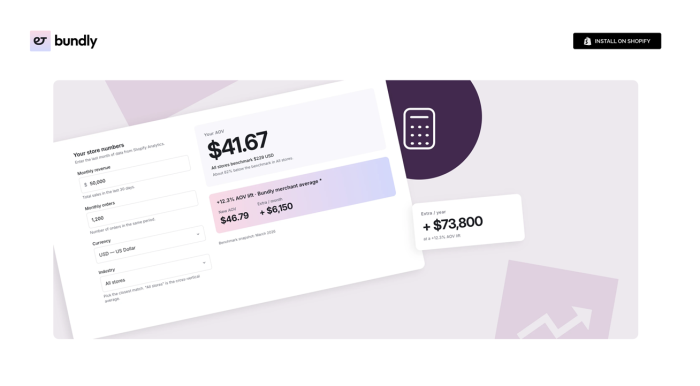
Before launching any bundling strategy, though, it’s worth running your current numbers through an average order value calculator to establish a clean baseline. Without knowing where you stand today, you can’t measure whether bundles are genuinely lifting spend or just reshuffling it.
The maths behind why bundles work
A standalone skincare moisturiser might retail at £24. Pair it with a cleanser and a serum as a “complete routine” kit at £58, and you’ve moved the basket from one SKU to three while giving the customer roughly 15% off individual prices.
The retailer still captures more gross profit per order because fulfilment costs don’t triple just because the box holds three items. Picking, packing, and shipping one parcel with three products costs marginally more than shipping a single product alone.
So the per-unit cost of delivery actually drops.
That gap between the small increase in fulfilment expense and the much larger increase in basket revenue is where the margin lives.
What makes a good bundle
Not every product combination earns its place. The bundles driving real basket size increases tend to share a few characteristics:
- Logical pairing. Items that solve the same problem or belong to the same use occasion, not random inventory thrown together.
- An anchor product. One item the customer already wants, surrounded by accessories or consumables they’d otherwise forget or buy later.
- A visible saving that doesn’t feel desperate. A 10 to 20% discount on the combined price signals value without training shoppers to wait for deeper cuts.
The retailers getting this wrong are the ones stuffing bundles with slow-moving stock nobody wanted individually.
Customers see through that immediately, and it erodes trust in the brand’s curation.
Thresholds, tiers, and the psychology of “Almost There”
Bundles don’t operate in isolation. The most effective AOV strategies in UK retail right now pair bundling with spend thresholds, like free delivery at £50, a gift-with-purchase at £75, or loyalty point multipliers above £100.
These thresholds create a psychological gap between what’s already in the basket and what the customer needs to reach the next reward tier.
When the suggested additions are styled as outfit pairings or “complete the look” groupings priced to push the total just past that threshold, conversion on the upsell climbs significantly.
This kind of nudging only works when you know your numbers cold. Retailers who regularly benchmark their average order value against category averages and seasonal trends spot opportunities faster.
A 6% lift in AOV across 200,000 monthly orders doesn’t sound dramatic until you multiply it out. That’s meaningful revenue without acquiring a single new customer.
Why bundles beat blanket discounting
The temptation during soft trading periods is always the same: slash prices site-wide and hope volume compensates.
It rarely does.
Blanket percentage-off promotions compress margins across every transaction, including the ones that would have happened at full price anyway. Bundles sidestep that problem because they add perceived value rather than subtract price.
A customer paying £58 for three products feels like they got a deal. The retailer still collected more per order than they would have from a single-item purchase, even with the discount baked in. That’s the fundamental difference.
Bundles grow the numerator (total revenue) while discounts just inflate the denominator (number of transactions at lower values).
Some retailers have started using tools like Bundly to test different product groupings and measure which combinations actually move the needle on basket size, rather than guessing based on gut instinct.
Getting the data right
None of this works without clean measurement.
You need to isolate the incremental revenue generated by bundles rather than just celebrating a higher headline AOV number. If your bundle is cannibalising three individual sales that would have happened separately, you haven’t gained anything.
You’ve just consolidated transactions. Segmenting customers by purchase behaviour helps here.
First-time buyers respond to bundles differently than repeat customers, and that distinction tells you whether your bundles are attracting or retaining. Running cohort analysis alongside your order value tracking exposes whether the AOV lift sticks over time or fades once the novelty wears off.
The retailers treating this seriously track bundle attach rate, bundle-to-singles cannibalisation ratio, and post-purchase repeat rates for bundle buyers versus non-bundle buyers.
That level of granularity separates the brands genuinely increasing average order value in retail from those just rearranging the same spend into different basket shapes.
Where This Heads Next
Expect UK retailers to push further into dynamic bundling through 2026.
Algorithmically generated product groupings personalised to each shopper based on browsing history, past purchases, and real-time inventory levels are already being tested by several mid-market and enterprise brands.
Instead of showing the same static groupings to every visitor, machine learning surfaces bundles most likely to convert for each individual.
The core principle stays the same, though. Give people a reason to put more in the basket by making the combination genuinely useful. Price it so both sides feel the value.
And measure relentlessly so you know exactly what’s lifting revenue and what’s just rearranging it.