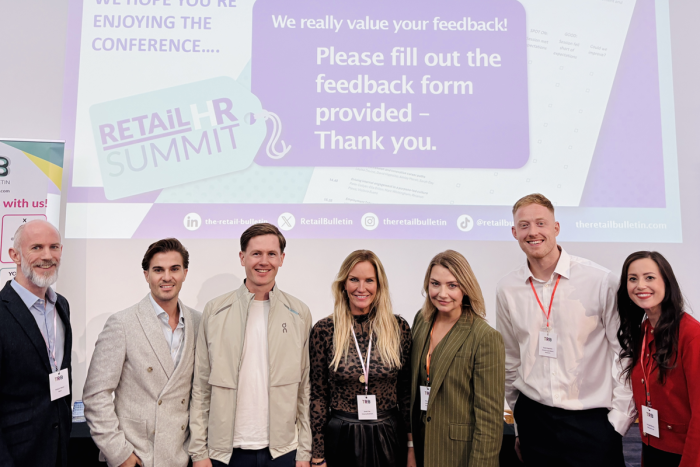
Retail HR Summit review – AI driving seismic changes in retail roles
Technologies including AI are having an ever greater impact on retail roles and HR are at the forefront of preparing people for this continuously changing environment by developing flexible workforces and equipping them with cross-functional skillsets.
Recognising and reacting to this perennial state of flux was an underlying theme at the recent The Retail Bulletin HR Summit 2026 in central London. Venessa Okonkwo, head of people & culture at Dock & Bay, told a packed room of delegates: “We have to ensure employees are experienced in what roles they could be in before they go into them. When we replace a role we replace it for the future so we’re hiring for the next 18-24 months. AI will not slow down and we can’t run away from it and so we have to understand cross-functional roles and step away from people saying it’s not their role.”
Subscribe to TRBWorking closely with leaders
Planning for these seismic changes involves HR working closely with business leaders, according to Kate O’Hara, human resources business partner, The Estée Lauder Companies Inc., who says: “It’s absolutely critical that HR professionals work with the leaders to ensure the right people are in the right place. Structures created five years ago are not what we need today or will need in the future. Things are ever-evolving and we’re trying to work out what we’ll need in the future.”
Liz Jewitt-Cross, founder & advisory partner at Future HR & The Coaching Solution, agrees: “Increasingly work will be less about organisational charts and more about skills and experience. We’re moving away from silos and more to cross-functional activities.”

She suggests we are moving away from static organisations and that leveraging AI will enable retailers to do more with less. However, this does not translate into job losses as Jewitt-Cross suggests only 5% will be replaced whereas 46% will be augmented by AI. “It’s about maximising and enabling humans to do better, more speedily,” she says.
Carefully handling of AI
Such a situation clearly unnerves many people in retail and this is something HR has to carefully handle, with Jo Causon, chief executive at The Institute of Customer Service (ICS), suggesting 80% of employees want to understand how AI will affect their jobs and that it will be used ethically. “We have an important role to play in how we interweave AI and companies are exploring new ways of working. But AI does not transform organisations, people do,” she says.
For Morven West, people lead at Saint + Sofia, an important role is managing one of the company’s co-founders’ enthusiasm for AI and ensuring it does not make people nervous in the business. “We’re on a journey and we need to get the team engaged with AI and see what [tasks] can be handed off to it. We currently have nine solutions running across the business,” she says.
Tom Bailey, global talent & leadership lead – people and organisation at Specsavers, says a lot of leaders in the business see AI as “useful shiny tool” but we need to see where the problems are in the business and how technology can fix it. He says around 700 leaders across the company have been identified and their confidence is being built around using AI and data.
Building AI literacy
“We need to build AI literacy across the whole business. A lot of our leaders are using Copilot to write emails but they need to think bigger,” says Bailey, adding that much of AI is used for tactical gains but that it must be considered for bigger opportunities.
He defines these as 10% efficiency gains versus transformational 10-times changes.The ramifications of AI on retail and HR are also unpredictable as seen by its impact on tribunal claims for unfair dismissal and disability discrimination claims. Stuart Lawrenson, partner & head of Solent office at Shoosmiths, says there has been a “massive” increase in claims as a result of claimants using AI. “They are now confident enough to make a claim without [engaging with] an employment lawyer,” he says.
This is causing work for HR departments and the judicial system, according to Stephen Wyeth, employment judge & barrister at 3PB Chambers, who says: “AI has come at the wrong time. It’s the perfect storm, with people also now able to put claims in online and make their representations via video.”
It is clear AI and its increasing impact is extending HR beyond its traditional domain and involving it in a multitude of disciplines. This is recognised by Okonkwo who has adapted her methods to “speak the same language as the CEO” whereby HR talks about the commercials – using data and numbers – supporting any argument, which she says is indicative of how HR and operations has become more intertwined.
Understanding the numbers
Knowing the numbers is on the agenda of Ella Dillon, senior comms & engagement manager at The White Company, who says the business has just launched a 12-month strategy and part of the roadshow that showcases this strategy involves being open with the numbers: “To get people behind a strategy they need to know the numbers. We’ve also launched a monthly trade communications.”
This resonates with Rhianon Plews, UK HR director at Watches of Switzerland Group, who says there was an assumption the teams understood the commercials. “One of the smartest things we did was to enable people to admit they did not know about them and then we did some learning around the P&L and now we are seeing some impact on the P&L,” she says.
Sharing of information is proving important at Boots UK too as Victoria Evans, head of benefits, wellbeing & recognition at Boots UK, says the business is reliant on its managers to communicate to the store teams and to boost the sharing of knowledge it has launched the ‘Colleague Promise’. She says it has helped reduce absences and when combined with the wellbeing programme at the company it has helped drive support levels for the workforce.
Multi-generational retail
Such is the increase in age ranges in the company that it has a 50-year club for employees who have been with Boots for more than half a century. There are more than 50 people in the club and Plews says you cannot communicate to these people in the same way as younger generations. “We have to support the older generations as much as younger ones. There’s no point in pushing out lots of webinars when lots of people can’t watch them,” she suggests.
Using a variety of communications methods is proving fruitful at The Perfume Shop as it uses the Dialogue tool from Workbuzz to undertake quick surveys of store employees. Jo Tyler, Head of People Experience at The Perfume Shop, says a question can be asked of the store teams who can respond via text, voice or video. AI then analyses all the feedback before giving management an objective view of this feedback.
Dawn Smedley, operational listening stategist at WorkBuzz, says: “It’s hard [for management] to be on the shop floor all the time. This solution helps them to [effectively] do this. It’s an extra layer to sit alongside engagement surveys. It allows operations directors to get to ask questions.”
Flexible communications
Such flexibility of communications is certainly helpful to older workers who are a feature of Brewers Decorator Centres that won an award for its employment of 55-plus year-olds. Jane Clifford, people director at Brewers Decorator Centres, says that when this grouping come in for interviews they see similar aged people in-store who are particularly good at dealing with customers. “There’s lots of interaction in our stores and we are open about how flexible we are with the workforce. We accommodate people when they have a family or get older,” she explains.
Louisa Devine, HR business partner at Shiseido UKI, agrees that flexibility is now more important when dealing with multiple generations: “It’s not always about pay levels but about softer elements too. We’ve seen a huge increase in flexible working. With multi-generation workforces you need to understand what each generation wants. How you talk to millennials will be different to other generations.”
For Mathew Dutton, chief people officer at Space NK, there are “four, pushing five generations” to deal with in the business and this has its challenges, especially for a rapidly growing organisation: “People end up managing people older than themselves. People might view the workplace differently and their priorities might be different. Part of our Management Skills Academy involves how to be adaptive to each team member.”
Opportunities abound
The openness of the sector in accepting a wide variety of people sets retail apart from many other industries and Ryan Cheyne, former interim group head of people at VetPartners, cites his own career as a great example. He started as a 17-year-old working in an Argos store to running an outlet aged only 20, with responsibility for a multi-million pound P&L and 30 people. “It was a fantastic learning experience and stood me in good stead. We need to show these things are still possible in the sector,” he says.
Joanna Bracegirdle, head of people at Bravissimo, recognises there is a perception versus reality issue with retail whereby the opportunities experienced by the likes of Cheyne are overridden by the fact the industry is widely seen as “hard work, transactional and with limited progression”. “The reality is you can pick up skills quickly, gain real world confidence and resilience, and leadership skills can be gained. This can all be overlooked though,” she suggests.
Clifford says retailers need to give a view of the next steps and make things accessible. “We put various courses forward and this creates a level of engagement,” she says, but acknowledges that there are challenges: “We are quite dispersed so how do we find the people with the talent and let them know about the opportunities available.”
Natural progression
For David Hippolite, senior people partner at the Victoria and Albert Museum, an important initiative is coaching employees so they can progress when the opportunity arises. “There is this natural progression. Often when a member of staff is absent we will have people who can step-up temporarily. So when a permanent role comes up then they can step in,” he says.
Although Ashley Marsh, senior talent business partner for UK retail at On Running, says people want to have a framework of their career but the reality is it is no longer linear so to embrace this the company has created an app-based career development map that is self-driven and gives coaching prompts.
On Running has also created a set of internships involving six-month stints in the head office for those people wanting to move out of store-based retail and into the office. “We’re on the third cohort and there have been some success stories with some permanent roles taken. It has enabled the pursuit of corporate careers,” says Marsh.
Alongside these positive stories there is no escaping the challenges the retail sector continues to face. Helen Dickinson, chief executive of British Retail Consortium (BRC), outlined some of these including the fact 400,000 fewer people work in retail compared with 10 years ago and of this reduction a third came in only the last two years.
Put people front and centre
She argues that the people agenda should be put front and centre even more so today and that retail must continue to be recognised as a major work opportunity – not forgetting that 780,000 under 25-years-old still currently work in the sector. Initiatives are underway to bring more youngsters into retail. This includes the BRC linking up with the DWP (Department for Work and Pensions) to launch a new work experience programme, Opening Shift.
This involves 18 to 24-year-olds looking for work being offered experience with retailers including Tesco, John Lewis, Waitrose and Curry’s. It will hopefully contribute to the BRC’s target of delivering 100,000 jobs for young people not in employment, education or training (NEET) by the end of this Parliament.
Impacting the desire of youngsters to work in retail is the continued levels of abuse and physical assaults faced by frontline employees. As many as 25% of people in the sector have experienced an assault in the past year, according to data from The Retail Trust. And Chris Brook-Carter, chief executive of The Retail Trust, says these actions are having the biggest impact on 16-25-year-olds where there has been a “big spike in churn rates and absence”.
Current churn rates are running at 43% in the sector but for those people who feel safe in their roles the level is only 16%, which is in stark contrast to the 60% level for those employees who feel unsafe. Feeling unsafe has undoubtedly been fuelled by the increase in lone workers. As companies have sought to reduce costs there has been a rise in single employees opening up retail stores in the morning and closing them at night.
John Seddon, senior business development manager at Peoplesafe, says the current climate involves retailers maximising value from their workforces and so reviews have been undertaken to see which stores can be run at quieter times with a lone worker. He acknowledges that CCTV has its functions and that body-worn cameras are a good deterrent but employees are still feeling unsafe when working alone. Peoplesafe has developed a hand-held technology solution that enables employees to trigger an alarm that is received by a person remotely who can initiate immediate action. He says one in three workers would take more shifts if they felt safe.